


About
A metaphor might seem like a mistake, a wrongly placed word, something that does not make sense but then, strangely, it does. As a figure of speech it adds new meaning: it refers to one thing by mentioning another, and by doing so, it detaches the affects of one area and passes them on to another. It is in this moment of transference that a crack appears, a dissonance that sparks the imagination for behavior and perception—while at the same time setting certain limitations and norms as some qualities are highlighted while others are obscured. Since metaphors are pervasive in everyday life, not only in language but also in the materialities that surround us, we often do not recognize the metaphorical origin of the words we use.
The internet is full of metaphors. In the late nineteen-eighties and early nineties, when the computer and the internet uncoupled from their original military and academic application and became more common, metaphors flourished, offering a shared language to make the new technology accessible and trustworthy. The internet was imagined as something that was outside of us, a world to be discovered—a ‘cyberspace’ or a ‘high-speed information highway.’ Today, the internet has become an integral part of everyday life in many parts of the world. In keeping up with this transformation, we no longer talk about the ‘internet’ or ‘going online,’ but use secondary terms that directly refer to our activities, such as ‘sharing,’ ‘swiping,’ and ‘posting.’
The role metaphors play in the language around computers goes even deeper. In fact, without metaphors we would not be able to talk about and with computers at all. Strictly speaking, our interactions with computers is primarily limited to clicking (with a mouse or trackpad), typing (on a keyboard), or touching (a touchscreen or trackpad), and it is only through the connection to metaphors and their manifestations in icons that our repeated movements gain meaning. Metaphors translate algorithmic processes into understandable icons and signs on the screen, enabling users to handle, modify, or manipulate them, without any programming skills necessary.
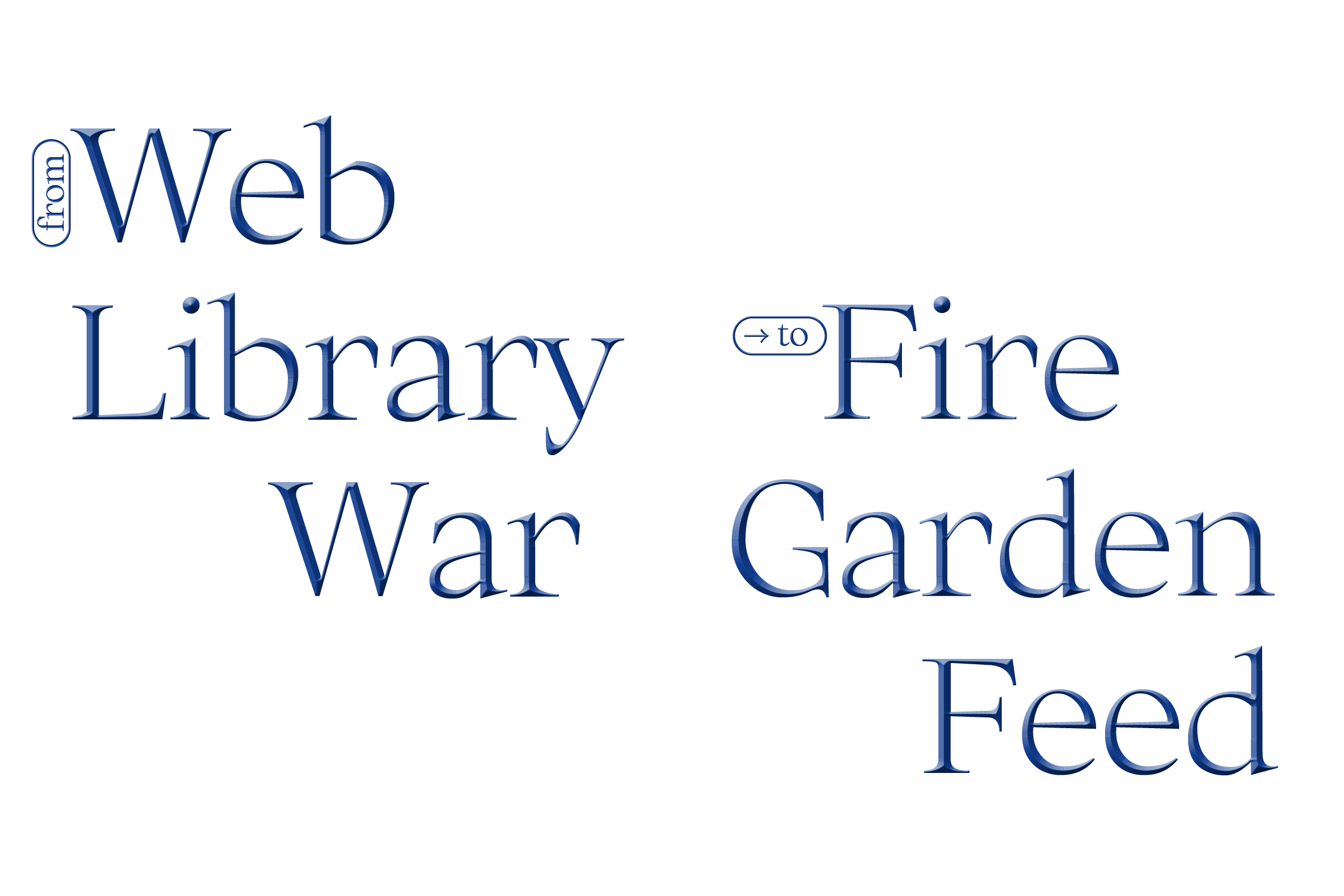
From Web, Library, War to Fire, Garden, Feed homes in on key metaphors to scrutinize imaginations of the internet and online experiences. The six metaphors of the project set up an overarching logic or idea of the internet. They spill over, build on, or mutually reframe one another. Some are older than others and sound odd, others are still in use or even omnipresent. The featured metaphors come from the English language and are rooted in a Eurocentric use of the internet. We decided to focus on them because they are close to our personal experience of the internet and influenced many other languages, including ours.
Web turns to an early metaphor, evoking both interconnectedness and entanglement—from the spider’s web and rhizomatic thinking to algorithmic traps, spiderbots, and nodes of (mis)information. Library reads the internet as an archive and universal knowledge system, reflected in file structures, search interfaces, and the enduring metaphor of digital storage. War takes the internet as a site of conflict, from cyberwarfare and automated military systems to online propaganda, hate speech and the weaponization of language. Fire captures the internet’s intensities, from overheating data centers and their environmental effects to firewalls, viral trends, and the burning acceleration of online attention. Garden treats the internet as an artificial biotope, shared by humans, bugs, and worms alike, shaped by gated monocultures and their extractive data harvesting, while grassroots efforts push towards permacomputing, digital rewilding, and commoning. Finally, Feed explores one of the defining metaphors of the contemporary internet. It describes the endless consumption and uninterrupted incorporation of content—from social media feeds and doomscrolling to the economies of attention that nourish, exhaust, and ultimately metabolize their users.
Events
Information following soon
Team
Medienfellows
Tereza Havlíková, Julia Kochanek, Anneliese Ostertag, Sasha Weber
Public Relations
Igor Štromajer
Webdevelopment
Paloma Oliveira